
Our tour of dystopia (see the last three posts) showed that creators have warned for decades about the risks of collapse, apocalypse or oppression. Their creations shape our cultural meanings and our sense of what is likely and possible. Those warnings are crucial but they are not the only type of creations we need. We also need imaginaries of better worlds, and these are much rarer, almost never the source of Hollywood blockbusters.
Why do we need to imagine better worlds? Because that’s the first step towards creating better worlds.
Imagination is…the beginning of all achievement. To imagine is to perceive many potential futures, select the most delightful possibility, and then pull the present forward to meet it.
The Director of the Imaginary Foundation
Before I develop this idea further, I want to talk about imagination. What is it and why am I so focused on it in this project?
What is imagination?
Definitions of imagination are myriad, from the prosaic to the poetic. Starting with the prosaic, the Oxford English Dictionary gives us:
The power or capacity to form internal images or ideas of objects and situations not actually present to the senses, including remembered objects and situations, and those constructed by mentally combining or projecting images of previously experienced qualities, objects, and situations.
Oxford English Dictionary
That’s helpful, albeit wordy. John Dewey was much pithier when he said imagination is ‘the ability to see things as if they could be otherwise’.1 Imagination involves forming images in our mind of things that do not (yet) exist. They can be images of the past, present or future. As Manjana Milkoreit puts it, imagination:
can involve states of the world that are no longer or not yet real (historical and future thinking, including prediction and scenario thinking), fictional worlds, but also dimensions of the world that are real but simply not open to sensual experience (e.g., abstract ideas such as democracy, socio-ecological system or identity; real but inaccessible places like the deep ocean).2
There’s a lot packed into these definitions, so some authors try to deal with the complexity by defining different types of imagination. In researching this piece, I’ve come across typologies with as few as three and as many as twelve types of imagination. One that attempts to be holistic but does not go overboard with defining different types is proposed by Anna Abraham.
Categories of imagination
In the Cambridge Handbook of Imagination, Abraham3 describes five categories of imagination:
- Perceptual or motor imagination, which involves formation of mental imagery to make sense of the input from our external senses. This is the routine imagination we use to create our sense of the world around us so that we can move through it, survive and thrive. Our brains integrate partial sensory input into something that seems real and complete using imagination.
- Intentionality or recollective imagination, which uses processing that is ‘primarily recollective in nature in order to arrive at the most plausible explantion of a given situation from the standpoint of what fits best with what one knows to be true’. This type of imagination is used in reasoning, moral decision-making, mental time travel / futures thinking and the narratives we create from our memories.
- Generative imagination, which creates novel combinations during creative thinking, hypothetical reasoning, counterfactual thinking and hypothesis generation. The German philosopher Johann Nikolaus Tetens used the analogy of Pegasus, the flying horse of Greek mythology, to describe this order or imagination. Flying horses do not exist but our creative imagination is able to connect images of horses and birds to create this entirely new thing.4
- Phenomenological imagination, which draws on our emotions and interior senses to generate aesthetic responses during appreciation of visual arts, music, literature and so on. This type of imagination creates the sensuous experience that can be evoked by works of art, beauty and meaning.
- Altered states of imagination, referring to ordinary states such as dreaming and meditation but also atypical states such as hypnosis, hallucinations, drug-induced states, delusions and so on.

All of these categories are of interest for this project but I am particularly interested in the role of imagination in intentionally exploring possible futures and generating novel ideas for alternative futures.
As holistic as this framework is, there is one addition that I find useful. A 2025 New Scientist article listed four types of imagination, three of which line up well with Abraham’s framework. The fourth is cultural imagination, our often invisible cultural heritage, the ‘cumulative creative product of human imagination’ that shapes the way we think and act. While we experience this cultural imagination through our senses and recollection, I think it is a valuable reminder that our cultures have been imagined into being over time and do not have to be the way they are.
Metaphors for imagination
Definitions and typologies are helpful, but it is often metaphors that help an idea to stick. What is imagination like? What can we compare it to?
Imagination is bricolage
Bricolage is a term used in art and literature to describe the creation of a work, product or solution using a diverse range of materials and resources that happen to be available. Geoff Mulgan refers to imagination as bricolage in his book Another World is Possible. The idea here is that imagination is an act of creative assembly from diverse, not-quite-fitting parts. It’s not a neat process and it relies on the meanings we already have available to us.
What this metaphor also says to me is that new ideas – novelty – don’t come from nowhere. Our imaginations stand on the shoulders of giants, drawing on what has been imagined before in our cultures. This means that, to be more imaginative, we would do well to expose ourselves to more unfamiliar ideas so that our minds can stitch them together in unfamiliar ways.
Imagination is a living thing
In The Improv Handbook, Tom Salinksky and Deborah Frances-White argue that:
The imagination is like a scared animal – it needs cossetting and encouraging.
Criticism of our ideas can lead our imagination to run for safety, to shut down, to be less bold. Extinction Rebellion take a slightly different angle when they argue that we need to ‘rewild our imagination’, which has become too tame, too domesticated.
For the imagination to thrive, it needs to be nurtured and it needs to be freed from the cage of assumptions and stale ideas.
Imagination is a muscle
Albert Read makes this his central metaphor in The Imagination Muscle. Like our muscles, the imagination can be exercised, it can be built up, it can become stronger through use. Just as we can improve our physical and mental well-being, so we can improve our imaginative well-being.
This metaphor offers a great deal of agency. Read studies the ‘historic activities fo the imaginatively muscular’ and argues that we can build our own imagination by adopting some of their practices:
to fully observe the world around us, be more comfortable with risk, make leaps across disciplines, have better conversations, build spaces that engender connection, understand the techniques of imagining and rediscover our profound relationship with nature.
Imagination can be thick or thin
Returning to Geoff Mulgan’s book Another World is Possible, he argues that:
we can distinguish what I call ‘thick’ imagination from ‘thin’ imagination. Thin imagination is vague and partial, whereas thick imagination combines ideas, philosophy, programmes and detailed implementation.
This idea that imagination has a textural quality, a thickness, is very generative for me. When we imagine the future, we frequently have only vague images in mind. I think this is particularly the case when we try to imagine better worlds – regenerative worlds, equal worlds, worlds that have never existed. It takes work to thicken imagination and we rarely find the time to do that work.
In fiction, this is called worldbuilding. Many of the enduring works of speculative fiction have invested a great deal of time in thickening their imagination through worldbuilding. J.R.R Tolkien was one of the first to do this with his creation of Middle Earth, using detailed maps of the world, invented languages and a rich history to provide depth to his fantasy novels. George Lucas also did this with Star Wars. I distinctly remember the thrill and confusion of being dropped into the original Star Wars movies at Episode IV, knowing that we were in the middle of a saga with a backstory that had not yet been revealed. These characters had a history and the universe felt more alive as a result.
Imagination is a teleporting time machine
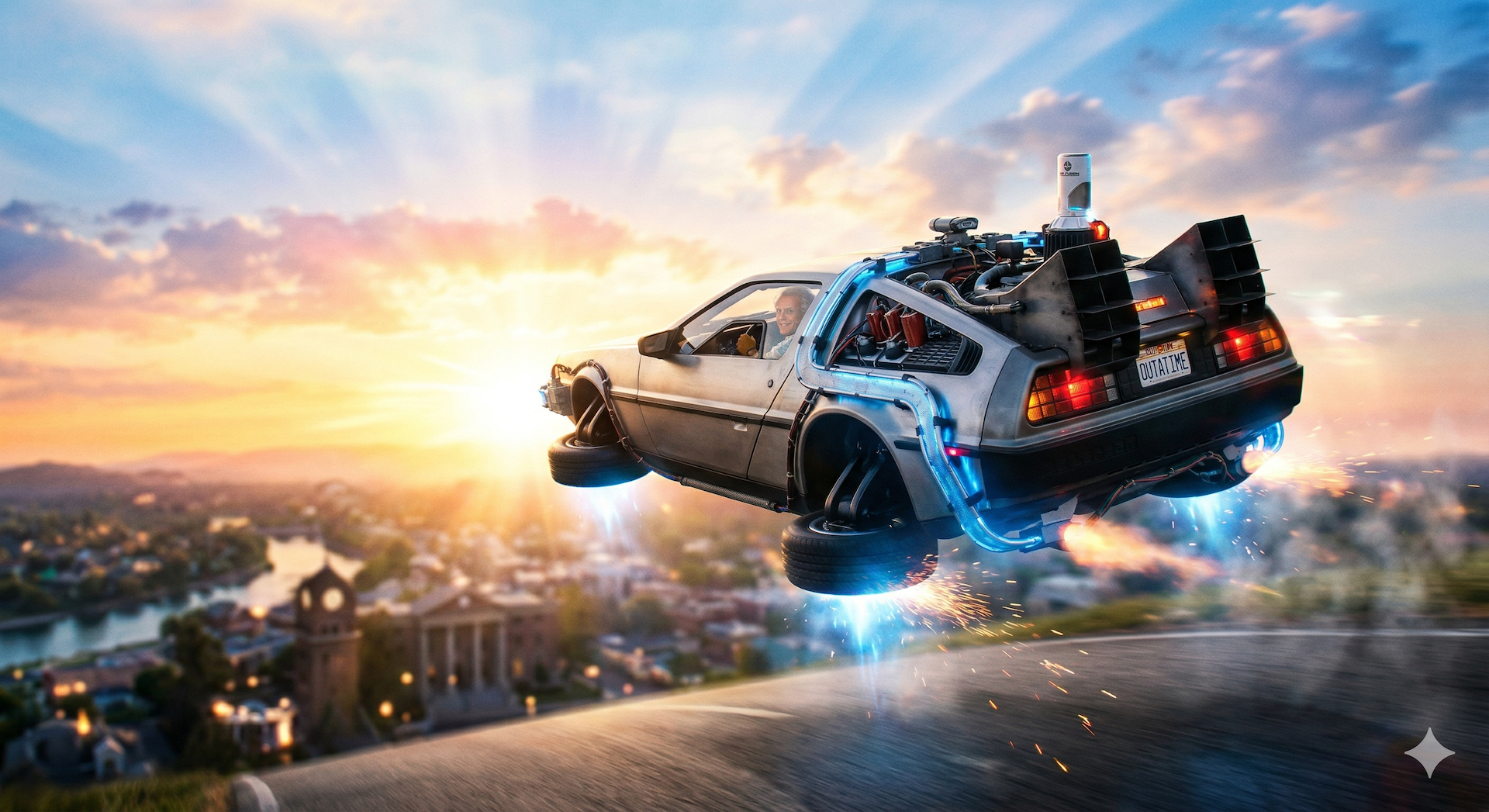
What I’m most interested in for this project is the prefigurative aspects of imagination – the ability to imagine future worlds and pathways that we want to make real. Imagination is a time machine that can carry us to past and future worlds. It is also a teleporter that can carry us to any place in our world, even to the stars, like Dr Who’s TARDIS.

Through empathy, imagination can even transport us inside the minds and lives of others, imagining what they think and feel and perhaps understanding their perspective a little more as a result.
Have you come across a great metaphor for the imagination? I’d love to hear more suggestions.
Notes
- https://www.resilience.org/stories/2020-07-01/introducing-the-imagination-sundial/ ↩︎
- Milkoreit, M. (2017). Imaginary politics: Climate change and making the future. Elementa: Science of the Anthropocene, 5, 62. https://doi.org/10.1525/elementa.249. Quote is from page 4. ↩︎
- Abraham, A. (2020). Surveying the Imagination Landscape. In A. Abraham (Ed.), The Cambridge Handbook of the Imagination (pp. 1–10). Cambridge University Press. https://doi.org/10.1017/9781108580298.001 ↩︎
- Read, A. (2023). The imagination muscle: Where good ideas come from (and how to have more of them). Constable. ↩︎
Leave a Reply