
To stitch together doom and hope, one must first thread a very fine needle.
Philip Smith and Nicolas Howe, Climate Change as Social Drama
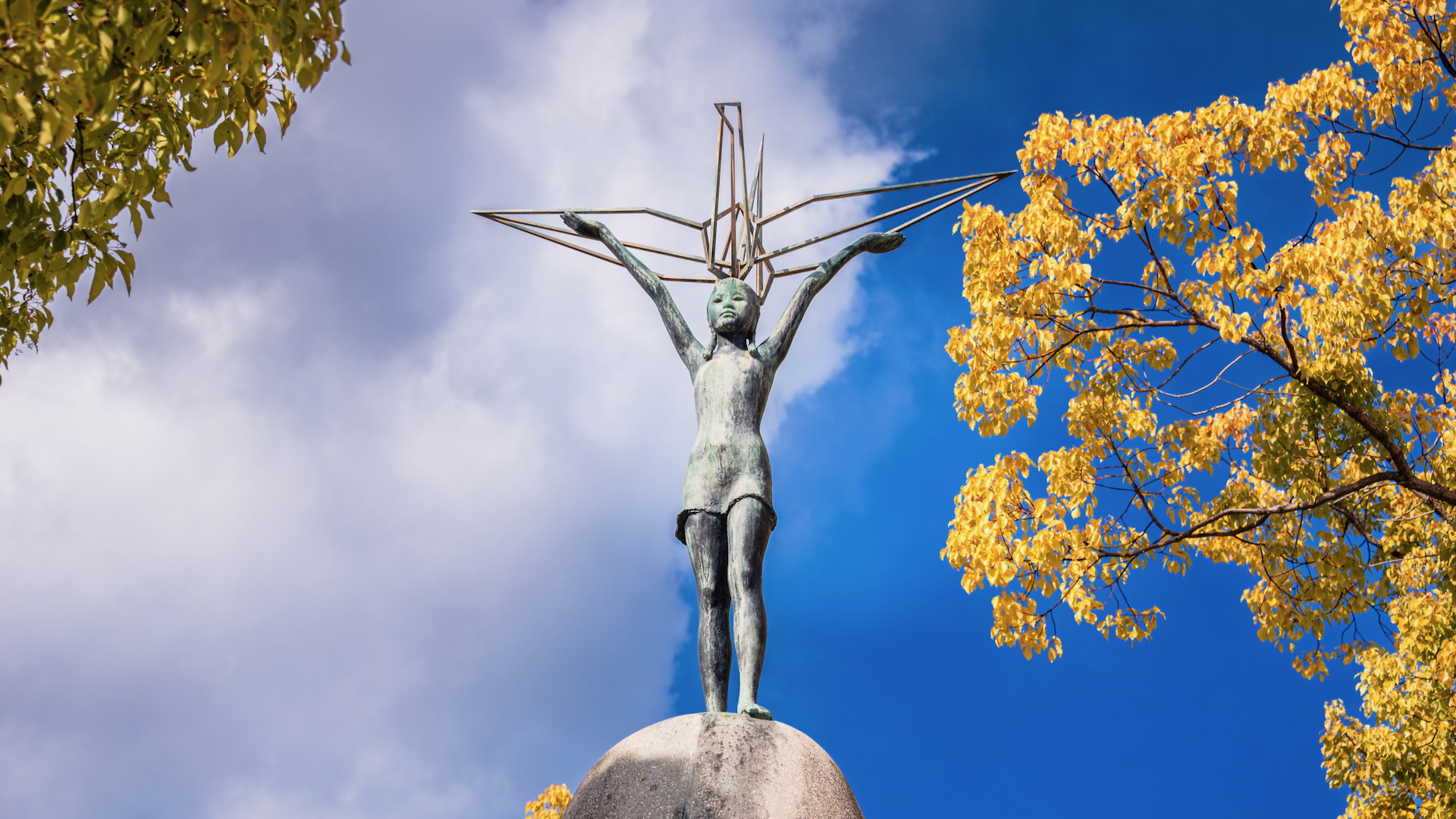
Hiroshima is thriving. Tourists stream along the beautiful Motoyasu River to the Peace Memorial Park, people fold origami cranes in the shade and the restaurants serve the most delicious okonomiyaki. It is a vibrant, modern city of 1.2 million people, visited by more than 15 million people each year.
If you grew up in the shadow of the mushroom clouds that ended World War 2, this feels surreal. How could a city recover from the devastation wrought on Hiroshima on 6 August 1945? How does life go on after such horror?
The scars remain. A Peace Memorial Park has emerged where the bomb once detonated. In it stands the Atomic Bomb Dome, the skeletal remains of a building destroyed in the blast. It stands as a reminder of the past, even as the city looks to the future.


In the Peace Memorial Museum, the horror is inescapable. The stories of survivors, images of people rendered into shadows by the blast, belongings left behind – it is heartbreaking, it is unbearable. Yet life goes on. Humans, and the rest of nature, are resilient. There is hope after apocalypse.
Many dystopian novels explore this idea of hope amongst the ruins. More than that, they ask the reader: what would you do if the unimaginable happened? How would you behave if the veneer of civilisation were stripped away? Would you hold true to your values or discard them in order to survive?
Perhaps the finest example is The Road by Cormac McCarthy. This 2006 novel achieved rare critical acclaim for dystopian fiction, winning the Pulitzer Prize in 2007. McCarthy drops the reader into a bleak future world without a word of exposition. We are introduced to a nameless man and a young boy, later revealed to be father and son. They walk through a devastated grey world, following the road south to escape chilling winter cold.

The man and boy don’t talk about how the world got to be this way. Names and history are meaningless in the relentless struggle to survive in the here and now. In time, there are enough hints to reveal that they are walking through a nuclear winter:
The clocks stopped at 1:17. A long shear of light and then a series of low concussions.
In economical prose, McCarthy imagines the unimaginable – a desolate post-apocalyptic world where nuclear war followed by nuclear winter have killed most of humanity and the few that remain struggle desperately to survive. There are almost no characters and most that the man and boy encounter are a threat, ‘bloodcults’ ready to brutalise them, kill them, eat them.

For me, what makes dystopian fiction so compelling is the exploration of what ordinary people would do in an extraordinary and hostile world. Will they compromise their values and join the bloodcults, doing whatever it takes, even becoming cannibals to survive? Does the world descend into a survival of the fittest, where power is all that matters? Or is there hope that some morality, some care for others would endure?
McCarthy’s characters grapple with these questions. They starve but refuse to stoop to cannibalism, seeing themselves as representatives of a better way. They talk of ‘carrying the fire’, a spark of a better humanity that needs to survive. They are the counter to the argument that humanity pushed to the brink will always give in to its basest instincts.

But there are no easy choices in this grey world. The man kills to protect them. He avoids risks to keep the boy safe, which means choosing not to help others they encounter on the road. The boy’s instinct is to help and he finds these choices unbearable. He pleads with his father to do more for the few lone souls that cross their path.
As we read, we are forced to question our comfortable assumptions about our own values. If it came down to it, would I not do anything required to keep my family safe, just as the man does?
The Road is an archetypal expression of a particular kind of dystopia focused on collapse or breakdown. It is a dystopia where nobody is safe and no-one is spared. There are no wealthy enclaves protected from a broken, dying world. There are no oppressive regimes to rebel against. It is bleak and unforgiving.
Like most dystopian stories, it is a warning. There are more than 12,000 nuclear warheads in the world today – enough to destroy all major cities and usher in a nuclear winter many times over. Those facts are numbing, meaningless, easy to ignore. McCarthy’s act of imagination projects them into stark, visceral reality. Once experienced, his narrative is not easily forgotten.
We have it in our power to take steps to avoid the bleak future depicted in The Road – and the other dark futures in countless other dystopian stories. This is a source of hope. Some will read or watch The Road and be inspired to take action, to march, to write letters, to vote differently. But given how ubiquitous dystopian stories are in popular culture, and how calamitous the state of the world remains, these warnings are clearly not enough.
There is other hope to find amongst the ruins. The love between the nameless father and son burns brightly in the dark landscape. The fire they carry is hope. Hope that the boy will survive, even as the father sickens and approaches death. Hope that he will pass the fire on to others, Hope that humanity can reconnect and rebuild even from this lowest ebb. Do they succeed? I won’t spoil the ending for anyone who is inspired to go and read the book or watch the excellent film adaptation.
While there is clearly hope to be found in dystopian stories like The Road, it is a meagre, flickering thing. I don’t want to scratch around for crumbs of hope in a dead world. I believe there are better pathways open to us, where purposive transformation delivers a brighter future. Maybe I believe this because I have to, or I choose to – because it keeps me going. What I am looking for is more stories where things go right – not perfectly, not without setbacks and struggle, but towards a world with more care, more thriving people and ecosystems and more peace.
Leave a Reply